Mastering the Art of the Multilayered Mandala: A Guide to Precision Laser Cutting and Design
The intersection of mathematical symmetry and artistic expression finds a profound home in the Multilayered Mandala. For creators, educators, and industrial designers alike, these intricate geometric patterns offer more than just visual appeal; they represent a complex challenge in material science, spatial reasoning, and digital fabrication. When transitioning from a two-dimensional concept to a tangible, nine-layered physical object, the nuances of design software and cutting technology become paramount. This guide explores the technical and creative dimensions of producing high-quality mandala art, specifically focusing on the workflows involving scalable vector formats and diverse material applications.
The Architecture of Depth: Understanding Nine-Layered Designs
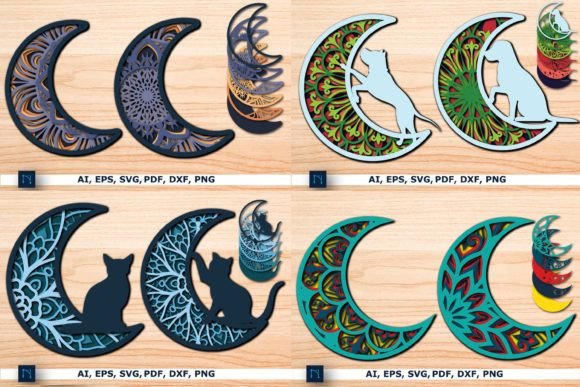
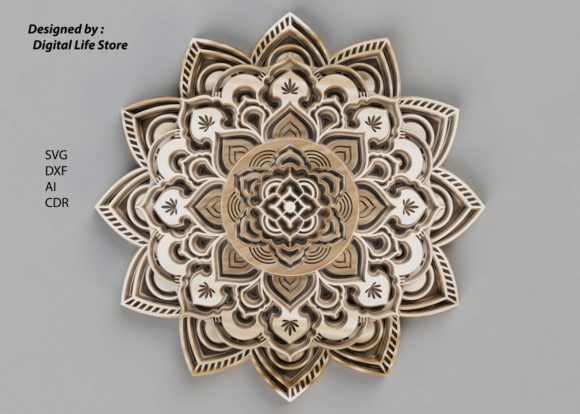
A standard mandala is often viewed as a flat, radial symmetry. However, a nine-layered approach transforms the piece into a topographical map of light and shadow. The depth created by stacking nine distinct layers allows for a dynamic interplay of perspective. As the viewer moves around the piece, different layers obscure or reveal underlying patterns, creating a kinetic visual experience even when the object is static.
The specific design referenced here, originally crafted by DigitalLifeStore, utilizes a diameter of 550 mm x 550 mm. This substantial size provides ample canvas for intricate detailing but also demands rigorous attention to structural integrity. In a nine-layer stack, the bottom layers must support the weight of the upper tiers while maintaining aesthetic transparency. If the design is too dense at the base, the piece becomes heavy and opaque; if too sparse, it lacks the necessary foundation for the delicate upper layers. The balance between negative space and solid material is the defining characteristic of a successful multilayered composition.
Scalability and Structural Integrity in Vector Files
One of the most critical aspects of working with digital cut files—whether in SVG, DXF, AI, or CDR formats—is understanding the physics of scaling. While vector graphics are theoretically infinite in resolution, physical materials have finite limits. The ability to scale a 550 mm design up or down is a powerful feature, but it comes with significant caveats that every operator must respect.
When increasing the size of a design, the primary concern is usually material availability and machine bed size. However, when reducing the design, the risk shifts to structural failure. As you shrink a nine-layered mandala, the thin elements connecting the various geometric shapes become proportionally smaller. At a certain point, these connectors may become too fragile to survive the cutting process or the subsequent handling. For instance, a bridge that is 2mm wide at 550mm scale might shrink to 0.5mm at a smaller scale, making it prone to breaking during weeding or installation. Therefore, when downsizing, one must carefully inspect thin elements and potentially adjust line weights or simplify details to maintain durability.
File Format Versatility for Different Workflows
The availability of multiple file formats ensures that the design can be integrated into various professional ecosystems:
- SVG (Scalable Vector Graphics): Ideal for web-based design tools and modern laser cutting software like LightBurn or Glowforge. It preserves scalability without loss of quality.
- DXF (Drawing Exchange Format): The industry standard for CAD programs. This format is preferred by engineers and architects who need to integrate the mandala into larger structural plans or use CNC routers that prioritize precise coordinate data.
- AI (Adobe Illustrator): Essential for graphic designers who wish to modify the aesthetic elements, such as adjusting curves, adding gradients for visualization, or preparing the file for print-before-cut processes.
- CDR (CorelDRAW): Widely used in sign-making and industrial laser cutting environments, particularly in regions where CorelDRAW remains the dominant vector editing platform.
Material Selection: From Organic to Industrial
The choice of material dramatically alters the final appearance and functional application of the multilayered mandala. Each substrate interacts with light and the cutting laser differently, requiring adjustments in power, speed, and layer adhesion methods.
Wood-Based Substrates: Plywood and MDF
Plywood is a favorite among hobbyists and interior designers for its warm, organic aesthetic. The visible grain adds a natural texture that contrasts beautifully with the precise geometry of the laser cuts. However, plywood varies in quality; lower-grade sheets may have voids in the inner plies that can cause uneven cutting or breakage in thin sections. MDF (Medium-Density Fiberboard) offers a uniform density and smooth surface, making it ideal for painting or veneering. It cuts cleanly with minimal charring, provided the laser settings are optimized. Both materials benefit from the depth of the nine-layer structure, as the stacked edges create a striped pattern that enhances the visual complexity.
Synthetics: Acrylic and Plexiglas
For a modern, sleek look, Acrylic and Plexiglas are unparalleled. These materials allow light to pass through, enabling the creation of illuminated wall art or lampshades. When using clear or translucent acrylic, the layers create a refraction effect, blurring the boundaries between levels and giving the mandala a floating appearance. Colored acrylics can be stacked to create gradient effects, with darker tones at the base and lighter tones at the top. It is crucial to note that acrylic melts rather than burns, so air assist and proper ventilation are necessary to prevent flame polishing edges unintentionally or causing flare-ups.
Experimental Media: Cardboard, Paper, and Metal
While less common for permanent installations, Cardboard and Paper offer excellent prototyping capabilities. They allow designers to test the assembly sequence and visual impact of the nine layers at a low cost. Corrugated cardboard, in particular, adds an interesting textural element due to its fluted internal structure. On the other end of the spectrum, Metal cutting requires fiber laser technology rather than CO2 lasers. Metal mandalas are incredibly durable and suitable for outdoor architectural features. The rigidity of metal allows for thinner connections between elements, enabling more delicate designs that would be impossible in wood or plastic.
Practical Applications and Real-World Use Cases
The versatility of the multilayered mandala extends beyond simple wall decoration. Its modular nature and visual impact make it suitable for a variety of professional and personal projects.
- Architectural Screens and Room Dividers: Large-scale versions can serve as semi-transparent partitions in open-plan offices or homes, providing privacy without blocking light.
- Educational Tools: Educators can use these designs to teach concepts of symmetry, geometry, and fractions. Assembling the nine layers helps students understand spatial relationships and sequencing.
- Lighting Fixtures: By integrating LED strips between specific layers, creators can build custom lamps where the light filters through the geometric patterns, casting intricate shadows on surrounding walls.
- Therapeutic Art Installations: In healthcare settings, the calming symmetry of mandalas is used to reduce anxiety. The tactile nature of the layered wood or smooth acrylic can provide sensory engagement for patients.
Assembly Techniques for Multi-Layer Precision
Assembling nine layers requires patience and precision. Misalignment at the bottom layer compounds as you move up, potentially distorting the entire pattern. Professional fabricators often use registration pins or jigs to ensure each layer sits perfectly centered. For DIY enthusiasts, dry-fitting the layers before applying adhesive is essential. Using a slow-drying craft glue allows for minor adjustments, while cyanoacrylate (super glue) offers instant bonding but leaves no room for error. It is also advisable to number each layer clearly during the cutting process to avoid confusion, as slight variations in color or grain can make distinguishing between similar layers difficult once they are separated from the sheet.
In conclusion, the creation of a nine-layered mandala is a testament to the synergy between digital precision and manual craftsmanship. Whether utilizing SVG files for a quick prototype or DXF formats for industrial CNC routing, the key lies in respecting the material constraints and embracing the scalability of the design. By carefully selecting materials and understanding the implications of scaling, creators can produce stunning, durable works of art that resonate with both aesthetic beauty and structural ingenuity.